How do we ensure the DNA we’ve extracted is not only present, but also pure enough for the next critical steps in metagenomics research?
Unlocking Quality: The Foundation of Metagenomics
Before diving deep into genomic analysis, we need to answer a fundamental question: Is our DNA sample ready? This isn’t just about having DNA; it’s about having the right quality and quantity of DNA. In this lesson, we’ll explore the critical techniques used to assess your DNA samples, ensuring they’re pristine and potent for successful downstream applications.
Learning Outcomes
- Explain what OD260 measures.
- Calculate dsDNA concentration from absorbance.
- Interpret the 260/280 ratio as a purity indicator.
- Understand why contamination affects quantitation.
For deeper background, refer to the course reading: DNA QUANTITATION — Spectrophotometry and Nanodrop.
Consider why knowing the exact concentration and purity of your DNA sample is so crucial before proceeding with expensive or time-consuming genomic sequencing.
Measuring DNA: The Power of OD260
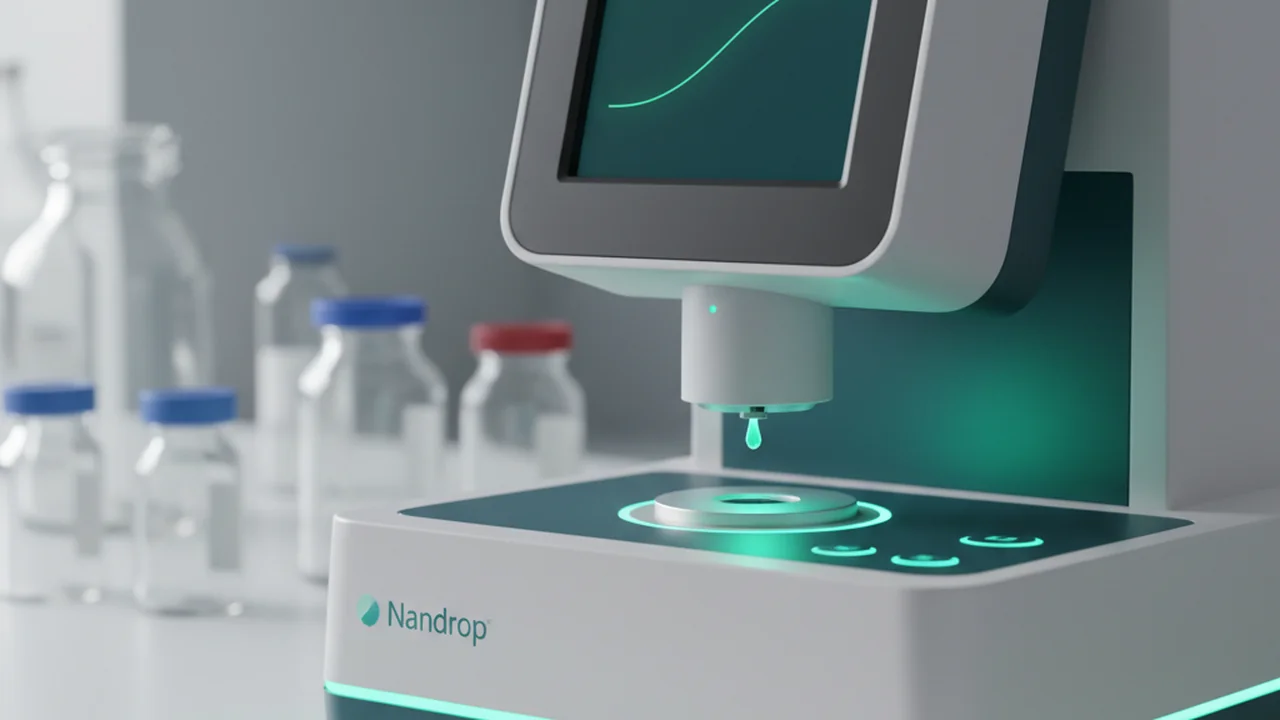
One of the most common and rapid methods for quantifying nucleic acids is spectrophotometry, specifically by measuring the optical density at 260 nm (OD260). Nucleic acids (DNA and RNA) absorb UV light most strongly at this wavelength due to the conjugated double bonds in their nitrogenous bases.
A spectrophotometric measurement of a sample’s absorbance at 260 nanometers, primarily used to determine the concentration of nucleic acids (DNA and RNA) in a solution.
The intensity of the absorbance at OD260 is directly proportional to the concentration of nucleic acids in the sample. However, different forms of nucleic acids have slightly different extinction coefficients, meaning they absorb light differently even at the same concentration.
The Beer-Lambert Law is the fundamental principle behind spectrophotometric quantitation. It states that the absorbance of a solution is directly proportional to the concentration of the absorbing substance and the path length of the light through the solution.
Optical Density Reference Values (OD260 = 1.0):
These values represent the concentration of a nucleic acid that yields an OD260 reading of 1.0 in a 1 cm path length cuvette (which NanoDrop instruments effectively simulate).
- dsDNA: 50 µg/ml
- ssDNA: 33 µg/ml
- Oligonucleotide: 20–30 µg/ml
- RNA: 40 µg/ml
The distinct OD260 reference values for dsDNA, ssDNA, oligonucleotides, and RNA arise from their unique molecular structures and stacking interactions. Double-stranded DNA (dsDNA) exhibits “hypochromicity,” meaning its tightly packed bases absorb less UV light compared to single-stranded DNA (ssDNA) or free nucleotides. When DNA denatures into single strands, the bases become more exposed, leading to increased UV absorbance (hyperchromicity). RNA, with its different sugar-phosphate backbone and often more complex secondary structures, also has a unique absorbance profile. These differences necessitate specific conversion factors for accurate quantitation of each nucleic acid type.
- You’ve learned that OD260 measures nucleic acid concentration.
- You understand that different nucleic acid types have different conversion factors.
Assessing Purity: The 260/280 Ratio
While OD260 tells us how much nucleic acid we have, it doesn’t tell us about its purity. Contaminants like proteins, phenol, or other organic compounds can also absorb UV light, skewing our concentration measurements. This is where the 260/280 ratio becomes invaluable.
The ratio of a sample’s absorbance at 260 nm to its absorbance at 280 nm, used as a primary indicator of nucleic acid purity, specifically for detecting protein and phenol contamination.
Proteins absorb strongly at 280 nm due to the aromatic amino acids (Tryptophan, Tyrosine, Phenylalanine). Phenol also absorbs significantly at 270 nm, which impacts the 280 nm reading. Therefore, a pure nucleic acid sample will have a characteristic 260/280 ratio:
Purity Assessment (OD260/OD280 ratio):
- Pure DNA: ~1.8
- Pure RNA: ~2.0
- Low ratios indicate protein or phenol contamination
A low 260/280 ratio means my DNA sample is simply less concentrated.
A low 260/280 ratio specifically indicates that your sample is contaminated with substances like proteins or phenol, which absorb at 280 nm. These contaminants interfere with downstream enzymatic reactions and can lead to inaccurate results, regardless of the perceived concentration.
In metagenomics, even trace amounts of contaminants can inhibit PCR amplification, restrict enzyme digestion, or interfere with sequencing reactions. A high-purity DNA sample is paramount for obtaining reliable and reproducible results.
Let’s put the OD260 reference value into practice. Use the provided example to understand how to calculate dsDNA concentration from an absorbance reading.
- Given: A sample reading at OD260 = 0.65
- Recall: The reference value for dsDNA is 50 µg/ml for an OD260 of 1.0.
- Calculate dsDNA concentration: Multiply the reference value by your sample’s OD260 reading.
- Convert units: Remember that 1 µg/ml is equivalent to 1 ng/µl.
Example Calculation:
Sample reading at OD260 = 0.65
dsDNA concentration = 50 µg/ml × 0.65 = 32.5 µg/ml
Conversion: 32.5 µg/ml = 32.5 ng/µl
This calculation shows you have 32.5 nanograms of double-stranded DNA per microliter of solution.
Using the NanoDrop 2000: In a laboratory setting, you will use the NanoDrop 2000 for all quantitation measurements. This instrument requires only 1-2 µL of sample and provides both concentration (ng/µl) and 260/280 ratio readings. It is crucial to record both of these values accurately on your tube label for proper sample tracking and experimental planning.
Why is it important to record both the concentration and the 260/280 ratio on your sample tubes?
Which of the following 260/280 ratios would typically indicate a pure double-stranded DNA sample ready for downstream applications?
Accurate quantitation of DNA concentration via OD260 and rigorous assessment of its purity using the 260/280 ratio are non-negotiable steps to ensure the success and validity of any metagenomic experiment.
Low ratios indicate protein or phenol contamination.
Imagine you’ve just quantified a DNA sample for a critical metagenomics project, and your 260/280 ratio is significantly lower than 1.8. Describe the potential implications for your experiment and what steps you would take to troubleshoot or rectify the issue before proceeding.
The Shift
- The optical density at 260 nm (OD260) is a direct measure of nucleic acid concentration, with specific conversion factors for dsDNA, ssDNA, and RNA.
- The 260/280 ratio serves as a critical indicator of DNA purity, where a ratio of ~1.8 signifies pure DNA and lower values suggest contamination by proteins or phenol.
- Accurate quantitation and purity assessment are foundational steps in metagenomics, directly impacting the success and reliability of all subsequent molecular analyses.