How do your daily financial choices—no matter how small—shape your future wealth, security, and opportunities?

Every financial decision you make today creates ripples into your future. A $5 coffee might seem insignificant now, but what if you bought one every day for 40 years? That same $5, if invested, could become thousands of dollars. This lesson explores how small choices compound—for better or worse—to shape your financial future.
The immediate effect of a financial choice, such as satisfaction, regret, or impact on this month’s budget.

The lasting outcome of a financial decision that unfolds over years, including wealth accumulation or financial hardship.

Missouri students who start saving as teens typically graduate with twice as much in savings as their peers who wait until after college.
Short-Term vs. Long-Term Consequences
Every financial decision creates consequences that unfold over different timeframes. Some choices bring instant gratification but may limit your future options, while others require patience and payoff later.
Imagine choosing between buying $150 designer shoes or saving that money. The shoes provide an immediate confidence boost, but investing that $150 could grow to more than $1,100 over 30 years at a 7% return.
“Small purchases don’t affect my future.”
Repeated small purchases compound over time, potentially costing hundreds of thousands in future wealth.
Think about your last impulse buy: What was its short-term benefit and what did you give up in the long term?
Decision Example: New Car vs. Used Car
Financing a new car for $35,000 brings pride and excitement, but after ten years, it loses value and consumes wealth. Buying a reliable used car with savings and investing the difference could grow to $100,000+ in ten years—wealth that the new car decision sacrifices.
Want to go deeper? The science behind delayed gratification
The Marshmallow Test showed that children who could wait for a bigger reward later ended up with better life outcomes, including financial success. This experiment illustrates the power of delayed gratification: choosing to invest or save for future gain rather than spend for immediate pleasure.
The Compounding Effect of Small Financial Choices
Small daily expenses may seem trivial, but repeated over years, they add up to huge sums. This is called the “Latte Factor.”
Practitioners use the Latte Factor to help clients see how their daily spending habits—like coffee, snacks, and subscriptions—could be redirected to build wealth.
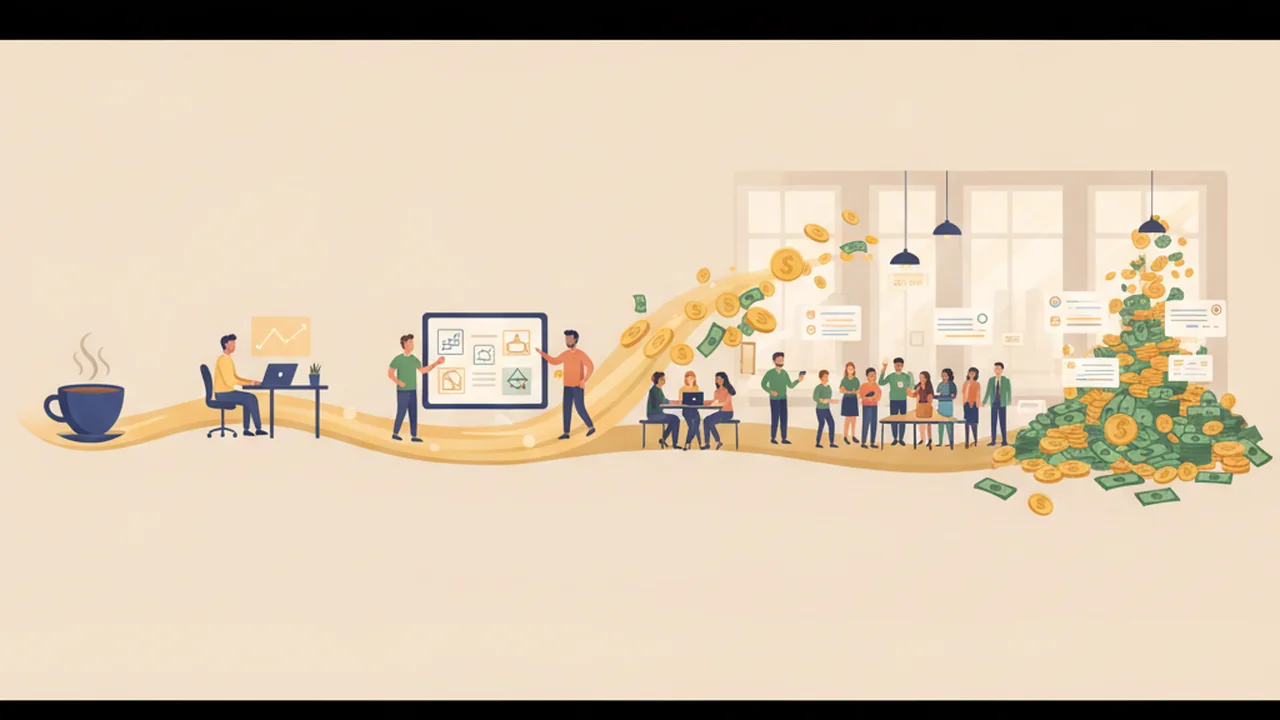
This is literally the difference between retiring comfortably or struggling.
Which daily or weekly “small” expense do you spend the most on? What could you do with that money if you invested it instead?
Common “Small” Expenses and Their True Cost
Here are typical daily habits and their long-term impact if invested at 7% annual return:
- Premium coffee: $5.50/day → $140,000 over 30 years
- Fast food lunch: $12/day → $305,000 over 30 years
- Vending snacks: $3/day → $76,000 over 30 years
- Lottery tickets: $5/day → $127,000 over 30 years
Combined, these habits can cost more than half a million dollars over a lifetime.
Estimate the future value of your daily spending.
- Pick one daily habit (coffee, snacks, etc.), note the cost.
- Multiply by 365 for a yearly total.
- Use a compound interest calculator to estimate its value over 30 years if invested at 7%.
- Write down the total—does it surprise you?
How does understanding the compounding effect change how you view “small” expenses?
Positive Compounding: Small Savings Habits
Automatic savings—even as little as $10/week—can grow to $107,000 over 40 years. Saving $100/month can become over $262,000. Starting early with small amounts beats starting later with larger ones.
The Real Cost of “I’ll Start Saving Later”
Early Emma invests $200/month from age 25 to 35 and stops, but her investment grows to $188,000 by age 65. Late Larry starts at 35 and invests $200/month until 65, ending with $244,000. Emma invested far less but nearly matched Larry’s result—starting early is powerful.
What is compounding?
Tap to revealCompounding is the process where money grows exponentially over time, as interest is earned on both the original principal and previous interest.
What is opportunity cost?
Tap to revealThe value of what you give up when you choose one option over another, such as spending now versus investing for future returns.
What is lifestyle inflation?
Tap to revealIncreasing spending as your income rises, which prevents you from accumulating wealth.
- Learned the difference between short-term and long-term financial consequences
- Understood how small daily spending habits add up over time
How Current Spending Affects Future Wealth
Your spending patterns today directly determine your financial future. Every dollar spent is a dollar not invested—and cannot grow.
Person B earns less but saves a higher percentage of income, ending up with three times more wealth than Person A. It’s not what you earn, but what you keep and grow.
How do you plan to balance enjoying your money now versus growing your wealth for the future?
Lifestyle Inflation: The Wealth Killer
When your spending rises along with your income, your savings rate stays flat and you miss out on wealth accumulation. Controlling spending as your income rises can lead to over $1 million more in savings over 30 years.
The Compound Cost of Debt
Debt works like negative compounding—your burden grows instead of your wealth. Credit card debt can double your costs over time, and student loans don’t just cost you interest but also compound growth you could have earned by investing instead.
Want to go deeper? Debt vs. Investing: The True Opportunity Cost
Paying interest on debt means you lose both the money paid AND the investment returns you could have earned. This double impact can significantly shrink your future wealth.
Small daily financial choices can compound into massive future wealth—or debt. The earlier you start saving and investing, the more powerful the results.
Case Study: The Latte Factor in Real Life
Meet Alex, a Missouri college graduate in their first full-time job. Alex’s daily spending habits add up to $511/month—over $6,000/year. If Alex continues as is, they save $89/month and reach $239,000 in 40 years. But by making small changes (like making coffee at home, bringing lunch, cutting unused subscriptions), Alex could boost savings to $358/month—reaching $963,000 in 40 years.
If you were Alex, which small expense would you cut or reduce? What would you do with the extra savings?
Awareness and intentionality about daily spending can transform future financial outcomes from average to extraordinary.
Projecting Future Financial Outcomes
Knowing how to calculate future values helps you make informed decisions. Use these formulas to estimate the impact of your choices:
Compound interest is the engine behind wealth accumulation—mastering it unlocks financial independence.
Future Value Formula:
FV = PV × (1 + r)^t
Where:
FV = Future Value
PV = Present Value (amount today)
r = Annual return rate (as decimal, so 7% = 0.07)
t = Number of years
Example: $1,000 today becomes $3,870 in 20 years at 7% annual return.
Future Value of Regular Savings (Annuity):
FV = PMT × [((1 + r)^t – 1) / r]
PMT = Payment amount per period
r = Return rate per period
t = Number of periods
The formula for calculating the of an investment is: FV = PV × (1 + r)t.
How confident are you that you can explain how daily spending choices affect long-term wealth?
Project: Trace the 10-Year Consequences
Course Driving Question: How can I build a realistic 10-year financial plan for my life after high school that can survive real-world trade-offs, setbacks, and opportunities?
Your project move: Show how one repeated choice could shape your Launch Profile’s future security and opportunities.
- Choose one recurring decision involving spending, saving, education, or work.
- Create a now, one-year, five-year, and ten-year consequence timeline.
- Estimate the financial effect and identify one nonfinancial effect at each stage.
Add to your Missouri Money Map: A consequence timeline with calculations, assumptions, and a recommended habit.
Trade timelines and flag one consequence that needs evidence or clearer reasoning.
Reflect: Think about one daily financial habit you could change or improve. How might that affect your future wealth and opportunities over the next 10, 20, or 30 years?
Which factor most powerfully boosts your wealth over time: earning a higher income, starting to save early, or spending less as your income rises?
The Shift
- Small daily choices, when repeated over time, have enormous impact on your future wealth.
- Starting to save and invest early is more powerful than waiting for a higher income.
- Intentional spending and avoiding lifestyle inflation can triple your lifetime wealth.